Showing posts with label Seattle. Show all posts

Tuesday, September 29, 2015

Bunka Gakuen Fashion Show at Seattle Central College

Got a call from my friend Lei Ann on Saturday: “I’ve got an extra ticket to the Bunka Gakuen Japanese fashion show!”
“The what fashion show?”

So each year, Seattle Central College hosts design students from Bunka Gakuen University’s fashion college, who put together an amazing show of clothing and multimedia at the Broadway Performance Hall. Somehow this has got past me every year, but since Lei Ann knows more about Cool Fashion Stuff than I do, this time around I lucked out. Also in attendance was Lei Ann’s adorable 12-year-old niece, who was getting extra credit in her Japanese language class for attending and taking pictures. (Why is there no extra credit in the Adult World? I cry foul.)

We were in the third row, which was handy, as all I’ve got is a cell phone camera; any farther away, and the models and clothes would have been even more bleached out and smeary in the pictures.

What I enjoyed about the show was the humor in the designs. My favorites were those that could be considered over the top, but which I would actually be more likely to wear. Is it red and fuzzy? Is it decorated with brocade cranes? Is there perfect symmetry? Is there no symmetry? Then take my order for 3 of each!

Basically, I'll wear anything that makes me look like I'm a 1700s Balkan Mountains peasant who lucked out and "married up" due to an extended dowry of four extra goats, three dozen rye sheaves, and a set of nearly new cooking pots. As with any shrewd woman, whatever gets some embroidered velveteen into my wardrobe.

The show was split into themed modules: “Invisible,” “Nighty-Night,” “Brilliant,” and other motifs that I’ve forgotten since leaving the performance hall. But here are some of my favorite outfits, glamorama poses, and graceful gestures.

The designers
Models after the show

Wednesday, May 7, 2014

The multicolor green girl: designer Carolina Wallin

Update! Read the Seattle Met article about Carolina and her studio in the May 2014 Behind the Scenes section.

Designer Carolina Wallin
I saw Carolina Wallin from halfway down the block, and she was a beacon of softened DayGlo, unassuming and Junoesque. “I love your colors!” I said as she passed, and she laughed and removed her stereo earbuds to say hello.

She immediately introduced herself, and we had a friendly chat right there. Carolina’s a designer from Sweden, and her line, The Green Girl, is a collection of jewelry, accessories, and clothes distinguished by clever meshing of geometrics, and unexpected color combinations. She was on her way to buy some plants for her studio, where Seattle Met magazine is doing a photo shoot of her designs this Friday. She and her husband just moved to Capitol Hill ten days ago, so she has been busy unpacking and preparing for the studio visit.

We talked materials—she designed her choker, comprising precision-cut craft foam—and gold vs. silver. I used to wear more silver, but have become more fond of gold over time. Maybe because of my wedding ring, which is a simple gold band. Carolina’s gold wedding ring is of her own design, and incorporates her grandmother’s ring.

She also designed her handbag, a mix of materials and hand embroidery on a gold chain. Gold and orange is a great combination, and the metal works so well with her blouse.
Carolina Wallin handbag
A handbag of Carolina's design


Carolina and her husband have lived in Seattle since this last January, and prior to that she designed for H&M after studying at Central Saint Martins College of Art and Design in London.

I simply was struck by her bearing, color sense, and unique style. I’m sure she’s finding an enthusiastic audience for her designs in Seattle.

Stay abreast of Carolina’s work at http://thegreengirl.se, and follow her on Instagram and Pinterest.

And don't forget to watch for Seattle Met’s story about Carolina, which will soon be online in their Fashion and Shopping section.

Tuesday, May 6, 2014

Mysterious ham: Press-Rite tailor's forms

How about some mustard with that ham?

This last weekend, my mom gave me the tailor’s ham and sleeve roll she’s had for ages. The first thing I did when she offered them to me was the same thing I did when I was ten years old: I put the ham under my shirt and pretended I was pregnant. Alas, my poor mother, stuck with a perennial ten-year-old child.

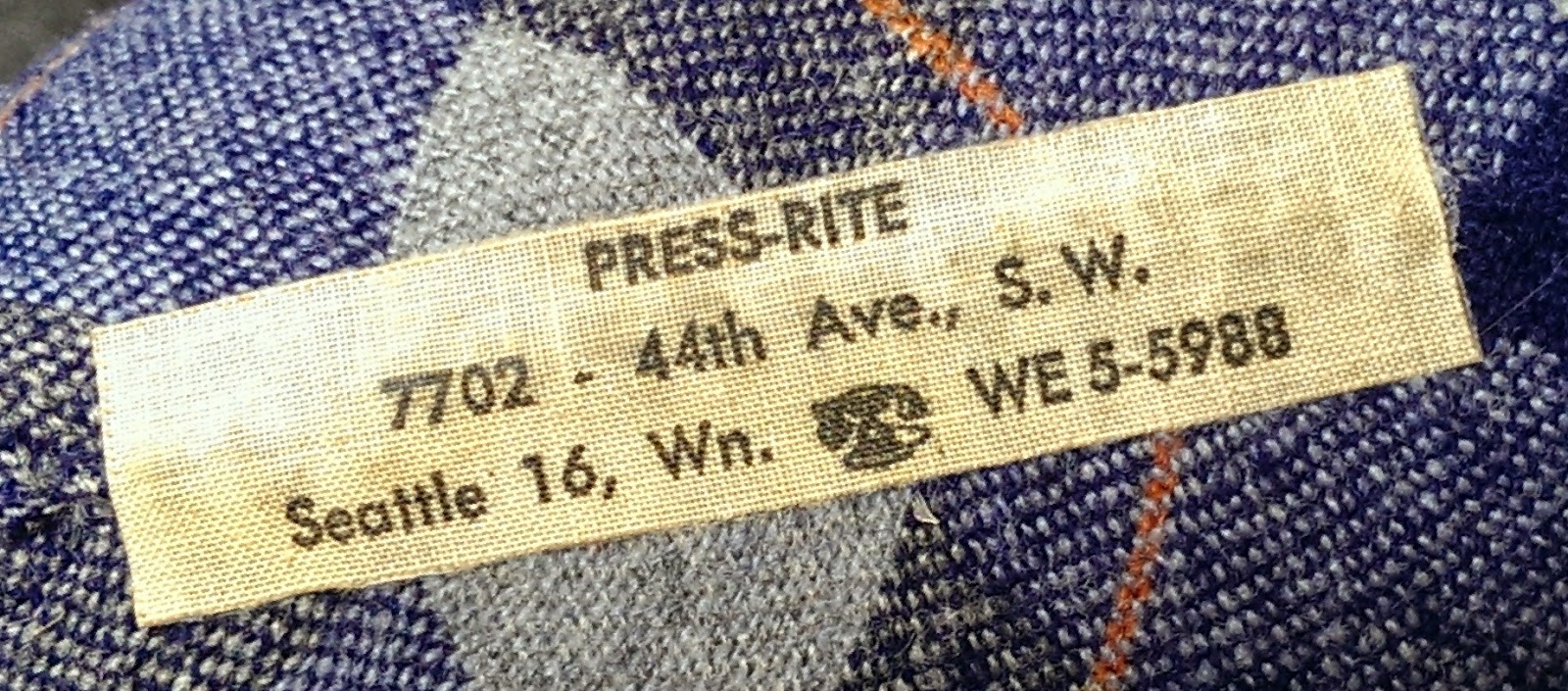
The manufacturer is Press-Rite, and I spent way too much time today on the web trying to find out what happened to the company. But other than a completed sale on Etsy for a Press-Rite ham, I couldn’t find any other information on this Seattle business. Mom doesn't remember where she bought it 50-some years ago—there were so many little fabric stores in Seattle at that time. She lamented the disappearance of these businesses. There even used to be a button store in downtown Seattle. Just buttons—that's it. Heck, Portland has a button store downtown; get with it, Seattle! Anyhow...

These forms were always in use when I was growing up, lying around the laundry room like tidy, compact, silent pets, keeping my dad's sleeves crisply ironed and the seam allowances on sewing projects open and flat. Unlike most new hams, which have one muslin-covered side, wool fabric covers both sides of these forms. The plaids are carefully matched at the seams, and the closing-ends are hand-stitched.
Neatly matched seams Carefully hand-stitched end

I did find out that the forms were made after 1958. The giveaway is the label’s 2-letter + 5-digit phone number. Prior to that year, the phone number format was 2-letter + 4-number. Also, it was produced before 1963, when 5-digit ZIP codes were introduced. Up to that point, cities used 2-digit postal zones. It’s strange that I couldn’t find a web site that lists old Seattle postal zones; but let it now be known that West Seattle contained zone 16.
The tailor's ham still has its manufacturer's label.
The interwebs told me that the 44th Ave. SW property listed on the ham's label sold in 2008, but the phone number on the tailor’s ham label is still associated with that location! Now, how can that be? I mean, usually when a new owner moves in, they start new phone service, right? Of course, demographic info web sites often contain information which is a conglomeration of old and new data. Maybe the old number got pulled from one database and reassociated with the new owner’s name. But it’s kinda weird.

Anyhow, I snooped some more, but couldn’t find out whether the previous property owner had a business at that address. So who was Press-Rite? Was it a home business? The hand-stitched ends tell me that it could have been. Can you see the basement, filled with boxes of dense cotton batting and rolls of wool melton in all shades of plaid? Then there’s a single industrial sewing machine—most likely gray or mottled metallic green—which weighs about 382 pounds. And a big, wooden thread rack on the wall. And a scratchy push-broom for cleaning up the jetsam.


Even if I didn't have a particular, fond history with these forms, I'd still find them interesting as objects, just as I do the button tin and seam ripper my mom gave me from her batch of well-used sewing tools. But our culture is at a strange place where we, well...objectify objects. We put them on shelves and admire their rusticity, yanking history's everyday utilitarianism into a realm of precious aestheticism, which sometimes seems obsequious to the object's creator.

What I'm saying is, someone sewed wool fabric ovals together, stuffed the form tight with batting, and stitched the ends together. By hand. Then put it aside, and started on another. And then my mom bought a couple of them, and kept them in a drawer to keep them free of cat hair, clean, and useful. And I like that.

After more than fifty years of use, these things are still as firm and new as ever, and ready for their next half-century. Which is more than I can say for myself, a tad less firm, following close behind them in age, chasing my ideals of form and function, aesthetics and utility.

Saturday, February 1, 2014

Patterns of the Past: A Visit to Patrica Nugent Textiles Design Studio

This week our fashion design class visited Seattle's Patricia Nugent Textiles. Lucky us! It's rare for beginning designers to get this kind of opportunity to meet with an expert in historical textiles and design, and we're fortunate to have a teacher like Julie Snow, who set up the studio visit.

Pat has a textile archive that numbers in the thousands, dating from the 1790s to 1970; that's a lot of fabric and paper. Her customers are designers of textiles, apparel, stationery...anyone who wants a unique pattern or design treatment pulled from the fabric bolts and graphic artist imaginations of the past.

Stacks and stacks of fabric tied neatly with ribbon.
The studio space is brightly lit, with tidy bundles of fabric and baskets with swatches mounted on cards. The textiles are categorized by labels a customer would use to describe what they're looking for, so when someone tells Pat, "Show me something that's kind of floral and art deco," she goes right to the category they need.

When a customer buys a design from Pat's archive, they have exclusive use of it. And often, they're not getting just one design. For example, say a print has separate floral and paisley design elements. The customer's designer can take apart the design elements and create new motifs. They can create a border treatment, make a new repeating design, reorient the elements—with one swatch purchase, they're getting as many different designs as their imagination allows.

In addition to fabrics, the archives contain original designs on paper.
Pat showed us some designers' books from the early 1900s, and for me these are some of the most fascinating parts of the archive. A book had page after page of designs from a single, unnamed designer who likely worked for a textile manufacturer. Painted in gouache, many of the designs were no larger than a half-inch across on a paper swatch not much bigger. Who were these designers? Were they artists in their off-hours? Their creativity and skill at the small scale was amazing. There was one tiny illustration of a man and a horse on its hind legs enclosed in what looked like a Hula Hoop. What the...? I should have got a picture, but didn't.  Coulda woulda shoulda.

Today I was telling a friend about the studio visit, and we talked about how common it is for artists to use their skills for making a living in a job that's not really related to their art. For example, my friend has worked as a graphic designer, but painting and photography are where her heart is. I've worked for years as a technical writer, but that's not why I studied Comparative Literature and poetry. But we all need to buy groceries and cat food, right?
Martin: house painter, artist, all-around Dude.

My husband's grandfather was a house painter, but an artist as well, and painted a mural of exploding Mount Vesuvius in his living room. Here he is at his easel; I wish I'd met him. Look at this guy! He's grooving on painting on canvas, and he'll get up in the morning and go paint someone's grocery store. I like to think that it's unnecessary for artists to fall into some sort of Gordon Comstock despair and think they're selling out if they make a living using a portion of their natural skills to put food on the table. That said, it's a pain in the rear to not get any time in one's life to work on one's art and instead use all one's skills to describe software menus.


Pat Nugent shows us vintage Suzani textiles.


Anyhow, there were plenty of designs to look at. After showing us some highlights of her collection, Pat was kind enough to let us (carefully) peruse the categorized baskets. If you have any interest in vintage textiles or design, this would be your candy store. Just looking at the swatches is inspirational, and got me thinking that instead of solids, I'd like to use some vintage patterns in my designs. I'm a big fan of prints from the 20s through 50s, and somewhere in Pat's archive is the perfect design. I think many of the students in our cohort will be returning to the studio as customers.

Thanks for the tour, Pat! And thank to Julie for setting up a very fun and educational evening!
UW students peruse Patricia Nugent's archives

Thursday, September 19, 2013

Chute your pants at Hointer

I stumbled upon the Hointer popup store at Pacific Place today. It's where the Restoration Hardware used to be. After scanning the poster-sized write-ups from Forbes, Geekwire, etc., in the front window, I was curious about this minimalist space peppered with suspended pants (not pants with suspenders, though) labeled with QR codes.

The nice young clerk in the shop was very helpful when I asked him about the business plan; very knowledgeable dude, which is always refreshing. Here're the basics of shopping at Hointer:
  • Cruise around the store and find jeans you'd like to try on.
  • Use your smartphone to scan the jeans' QR code tag. (This requires you to download their app, which is available for iPhone, Android, and Windows). You can also ask a clerk to scan the tag for you, if you don't want to download the app or your phone is being used by your dog/toddler/grandchild. Another option: hold your phone up to the accompanying NCF (near field communication) tag.
  • The app asks you for your size, and you tell it the usual lies.
  • The item is added to a virtual shopping cart, and you can keep shopping, or click a "try on" button, which tells you which numbered dressing room to use.
Now, I think the best part of this is how your jeans get delivered to the dressing room. So if you don't want to miss the fun, be within striding distance of the dressing room when you click "try on." Because your jeans get delivered to your room down a chute in the wall!

That's right, a mechanized delivery system works its magic like tiny orphan hands replacing empty spools in a Victorian England cotton mill. My hope is that you feel free to sing Raymond Scott's "Powerhouse" in a doo-dee-doo fashion while donning your fresh-from-the-robot-hands pants.

It's an interesting business plan: target customers who want to avoid the kerfuffle of digging through racks and shelves, and give the product 360° display space so people can picture what their bums will look like in the jeans. "Showcasing," the consumer behavior of snooping around a brick & mortar retail shop to check out products  and pricing before heading to the web to purchase, is giving both online and physical shops a run for their money. So this is an interesting idea that bridges those two shopping experiences.

One thing that Hointer has invested in is customer service. The two guys I spoke with where very friendly and helpful. So if you still want to interact with humans while you shop, Hointer's filling that need.

So what do you think? Is this type of shopping for you? Have you shopped at Hointer? What did you think?

Friday, September 6, 2013

Robi at Rachel's Ginger Beer


I saw Robi through the window as I walked down Pine street. She was at the big open patio door of her daughter's shop, Rachel's Ginger Beer, on Post Alley in Pike Place market. Robi's turquoise sweater, ikat-ish scarf, and silver cuffs were complemented by the colorful growler bottles chilling on ice (in a galvinized holding pen, lest they should rumble away) and the little sample cups of pale yellow and blood orange ginger beer.

This photo (hey, man, I only have a camera phone!) doesn't do Robi and her ensemble justice. So I swiped a pic of some RGB growlers so I could put it next to Robi & you could get the full impact of something fresh and summery as we run out of summer. (Boo hoo!)

You'll have to go see her in person and try some of Rachel's spiceriffic, not-too-sweet fizzy goodness. And they'll put it into a cocktail for you. Yes. A booze cocktail. Not for the kiddies.

Thursday, September 5, 2013

Pink shoes and purses: Ann Marie

Stopped by the downtown Nordstrom today to see my cousin Ann Marie, who'll expertly guide you through the colorful labyrinth that is Nordstrom Designer Handbags.

Ann Marie has always had un senso elegante stile (I can say that because she's half Italian), and today she looked fantastic, as always. Don't the pink flats just make the outfit?

Because I tend to shop by feel (If I don't like the feel of a textile, why would I want it near my body?), I became aware that, while we chatted, I was being too fondley with the leather goods. I had to remind myself that, no, you are not in a tack shop in 1975 (which is a perfectly approprite time and place to put your hands all over bridles and saddles), and that you are in a very nice department store, so stop handling that red Proenza Schouler bag as if it were a blob of cinnamon roll dough.

By the way, Ann Marie gave me some interesting info on purse leather: when leather is tanned, it's fed through rollers to press it smooth. Then it's put through another treatment to add the grain back in. So the different finishes and textures on leather goods are actually created per the designer's specifications.

So next time you go feeling up handbags, thank your lucky stars for those dudes (or ladies) manning those big roller machines in the tannery. They're keeping you stylin'.

Phyllis Diller chicken

I remember seeing Phyllis Diller do stand-up on TV, and thinking, "Wow, that is some amazing old lady up there in that mini dress & awful hair." She was completely unlike anyone I'd met, because I mostly grew up around Quiet People of the Northwest. Who wore loud dresses like that? Certainly no adult whom I knew.

Being in horse 4H, my sister and I spent several days each summer at the fairgrounds. We'd constantly tour the barns when we weren't preparing for or attending show classes, and we loved visiting the poultry barn. We called any chicken with a crazy, tufty mop-top a Phyllis Diller chicken.

Today I was walking through Westlake Park and saw the back of some booths, and the words "Puyallup Fair" on a banner. And then I saw it: a petting zoo.

Now, I get a little squee-nutty around farm animals. I adore them, and want to take them all home and give them lemon bars and serve them tea in dainty china cups. So when I saw the pygmy goats, sheep, the rabbit, and the two chickens at the little mini-farm, whose intention is to lure us city folk to the state fair that starts this weekend, I was all over them like the kitten who shredded my hand in Mexico this spring. Except, unlike the kitten, the petting zoo inhabitants mostly ignored me. And there was no blood shed. And no rabies shots afterwards.

We should be so lucky to be like Phyllis Diller when we're older. Actually, we should be like her now, fashion sense and all. This little chick's for you, Phyllis.

Miss Springfield

My friend Melissa is probably the epitome of someone whose style is integrated into her everyday life. Her style is straightforward and chic, and once in awhile has post-modern quirkiness (whatever that is) tossed in.
Melissa in her frayed-hem jeans and Chanel shoes

But her fashion sense is not her identity, nor even an extension of it. It's like, you know you've met a farm girl because she simply knows how to carry a bucket. Or a woman who watched her mom cook, because of how she browns a roast and snips the string after she takes it out of the oven. That's how Melissa is with her personal style.

You know—like a really good roast in a bucket. (I kid! I kid!)

It also helps that Melissa is simply lovely, and she could put on a burlap potato sack and look gorgeous. So basically, Melissa is as wonderful as roast and potatoes.

She moved from Seattle to London recently, and I miss her. I am hoping she'll be my foreign style correspondent.


Wednesday, September 4, 2013

Stylin' northern neighbors

Went down to Uwajimaya to see if there were any interesting Japanese fashion mags featuring foldy-origami-ish clothes, but most of what I saw was the same batch of styles that any U.S. magazine has. There were some nice books in the craft section (drape drape is particularly interesting), but I didn't feel like dropping 25 bucks today.

They both admired these Dress to Kill pants at Momo
  So I headed to Momo to visit my friend Lei Ann. She wasn't in, but Tom was, as well as these two fashionable ladies visiting from Vancouver, B.C.

I noticed them when they came in the shop: I love drapey linen clothes, and these women were stylish and confident in all their flaxy glory. And no wonder they're stylin': one of them owns Urbanity, a clothing shop in Vancouver. Will have to check it out next time I head up north.

Decades of style: my mom

It's only appropriate that the first post of this blog should star the woman who knew Frederick & Nelson Tea Room first-hand. My mother was fashionable then, and still is. She has an eye for detail, and most important, has always known what flatters her shape, coloring, and style.

One of my mother's first jobs was in the Seattle Bon Marche Infants' and Children's department in the 50s. She and friends would dine at the fantastic standbys that used to feed and entertain Seattleites who worked downtown: Other Place, Outrigger, Pancho’s, and Plaid Piper. Rhodes Department Store had a lovely  restaurant overlooking the main floor, and a live organist. There was Trader Vic’s, and Von’s, both great places for cocktails.

Up to around the 50s, a department store clerk wore a black dress and a string of pearls. It was a simple, elegant time for fashion. During WWII, rationing had limited the availability of fabrics and colors, and as usually happens, restrictions create new standards which are adopted and altered: when manufacturers aren't allowed to put cuffs on blouses, people figure out other ways to lend style to outfits.

Here's to Mom! 

This is probably at the Arboretum Japanese Garden
At my grandparents' house in Fremont
At The Fat Hen in Ballard, 2012